Know the deck
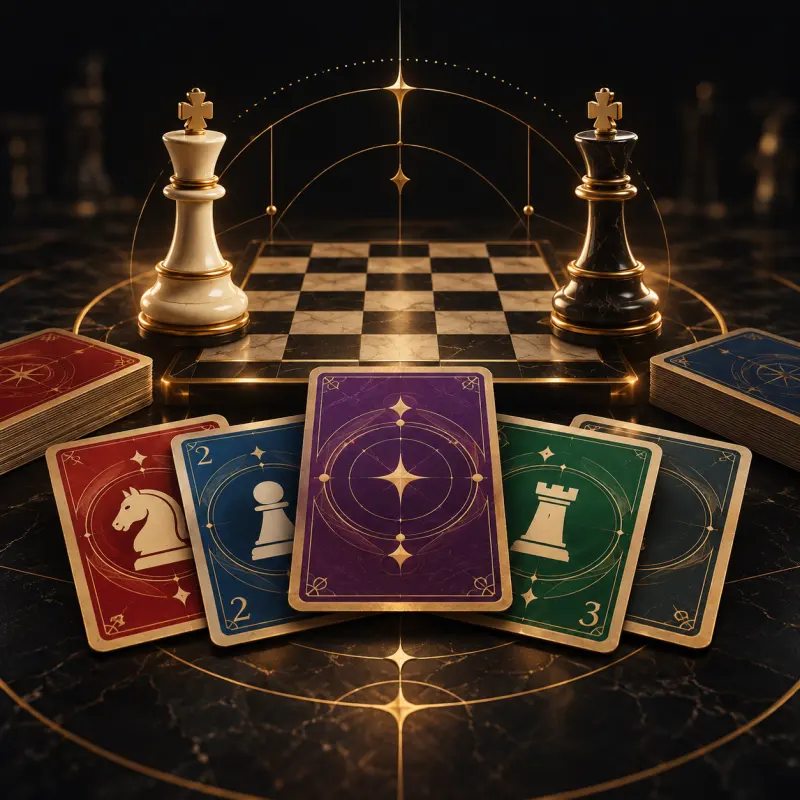
A game uses 72 cards by default. Nobody keeps cards in hand: each draw is shown to both players, then goes to the discard pile of the player who drew it.
| Card | Copies | Chance on a draw |
|---|---|---|
| 7Number 1 to 5 | 40 (8 of each value) | 56 % (11 % per value) |
| ↷Skip | 8 | 11 % |
| ↻Reverse | 8 | 11 % |
| +2+2 | 8 | 11 % |
| ♛Joker | 4 | 6 % |
| +4+4 | 4 | 6 % |
Two figures are worth remembering. A little more than half of the draws give a series of moves, three on average. And 56 cards out of 72, almost four draws in five, give the player at least one move with the army they already control: number cards, +2, +4 and Joker.
The discard piles are public and only go back into the draw pile once it is empty. You can count: if five Reverses already sit in the discard piles, only three are left among the cards still to come. The cards guide explains each effect in detail.
Never leave your king where one move takes it
In King Hunt mode, when the opponent gets the move and one of their moves can capture your king, the game ends at once. Every card that gives them a move does it, so an exposed king at the end of your turn loses about four times in five. Only a Skip or a Reverse drawn by the opponent saves it.
Before you end a series, look at every enemy piece that could reach your king in one move. Then look again with the Joker in mind: with a Joker, any enemy piece moves like a queen for one move, so a knight or a pawn on an open line to your king can take it too. Keep a piece or a pawn between your king and the long open lines, and do not walk your king onto the opponent’s third rank: pawns put back by a +2 or a +4 land on the starting rank right next to it, and one of them can take it as soon as the moves begin.
In Purist mode your king can never be captured, but the same habit pays: a king with few safe squares is the one that ends up checkmated.
A check ends your series
In both modes, the move that attacks the enemy king is the last move of your series (in King Hunt this is the series safeguard, on by default). With a 4, play your three quiet moves first, such as developing a piece, bringing a rook over or taking what is free, and give check with the last one. A check on the first move throws away the rest of the card.
A check is not a win either. In King Hunt the opponent then draws: almost any card lets them run, block or take the checking piece, and a Reverse is worse for you. The armies swap, they take over your attacking army, and its capture of the king, which is now yours, ends the game in their favour. In Purist mode a Reverse drawn in check hands the check straight back: you now play the army in check and must parry, or you are the one checkmated. Check when the king has no way out, not by reflex.
Use a series, or stop it early
The first move of a series is mandatory if one exists; after it you may stop whenever you want, and the same piece may move several times. Big cards are made for plans that need time: a knight that crosses the board, castling followed by a rook lift, a passed pawn pushed two or three squares in one turn.
Each extra move can also open a line to your own king. If the fourth move of a 5 would leave your king exposed, end the series after three. A strong move that hands the opponent an automatic capture is the most common way to lose in King Hunt.
Keep pawns in reserve for +2 and +4
A +2 or a +4 puts back your own pawns that the opponent captured, on free squares of your starting rank (rank 2 for White, rank 7 for Black), then gives you one move. Three consequences:
- Losing pawns is not pure loss: each captured pawn waits in reserve for your next +2 or +4.
- A card with nothing to put back only gives one plain move. Keep a free square or two on your starting rank, and keep some captured pawns in reserve.
- Pawns put back can shut a line to your king or protect a square. In Purist mode, a pawn put back that gives check ends your turn at once, so place the other pawns first.
Prepare for the Reverse
A Reverse swaps the armies without moving a single piece, and the player who drew it plays one move with their new army. With 8 Reverses in 72 cards, one turns up about every nine draws, for either player.
- A lopsided position can change hands. When you are clearly ahead, cash in quickly: trade pieces, take the king or go for mate instead of building an enormous advantage that the opponent might inherit.
- When you are behind, keep the position complicated and the pieces on the board: one Reverse and the stronger army is yours.
- In King Hunt, a Reverse drawn while your king is attacked wins the game on the spot: you take over the army that attacks it.
Choose your mode
Purist is chess with cards: checkmate, no king left in check, pinned pieces stay pinned. King Hunt keeps the original rules: you win by capturing the king, and leaving your own king attacked is allowed, if risky. The guide to the game modes compares them point by point. The ranking is shared, but the ranked queue only pairs players who picked the same mode.
Practise against the computer
Games against the computer, at Easy or Medium level, do not change your rating, and you can choose the cards in the deck. They are the best place to try a plan, such as holding back a check until the last move of a series or keeping pawns in reserve for a +4, before you use it in a ranked game. The computer only sees what you see: the board, the revealed card and the discard piles, never the order of the draw pile.